Talking to reporters from Vietnam Financial Times (TBTCVN), Mr. Nguyen Ngoc Quynh - Deputy General Director of Vietnam Commodity Exchange (MXV), said that in the second quarter, Vietnam's export rubber prices will be affected. stronger due to concerns about weakening demand in China, when nearly 80% of our country's rubber is exported to this country. It is expected that the export price of rubber in Vietnam may be below 1,500 USD/ton, although slightly down compared to the present time but still a high level compared to last year.
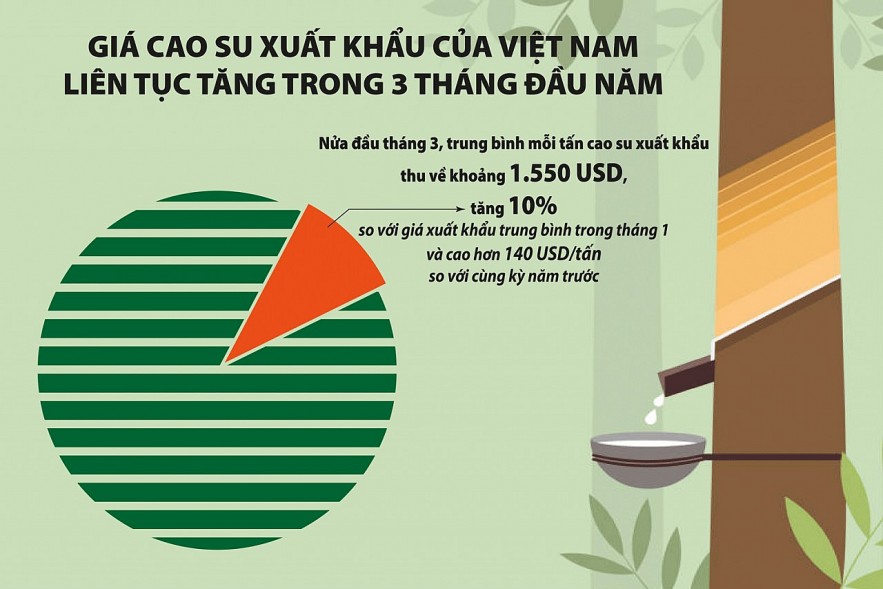
Source: Vietnam Commodity Exchange. Graphics: Phuong Anh
Reporter: How do you assess the situation of the domestic and world rubber market from the beginning of the year until now?
Mr. Nguyen Ngoc Quynh: I think that in the first three months of the year, the world rubber market has witnessed many new records on the Osaka Exchange (OSE) in Japan and the Shanghai Exchange (SHFE) in China. Quoc. Notably, rubber prices traded on the OSE reached a 7-year high on March 15 with a closing price of 352 Yen/kg, up 36% and 57% respectively compared to the beginning of 2024 and the same period last year. 2023.
Meanwhile, rubber price movements on the SHFE Department are relatively stagnant in the first 2 months of 2024. During this time, natural rubber prices in China fluctuated between 13,250 - 14,000 Yuan/ton, equivalent to equivalent price range in the same period last year. However, in March, rubber prices at SHFE began to increase dramatically. According to our records, in the first 20 days of March, rubber prices on SHFE increased by 13%, to the highest level in three years at 15,480 Yuan/ton and 33% higher than the same period last year.
On the domestic market, Vietnam's export rubber prices also continuously increased in the first 3 months of the year. In the first 15 days of March, on average each ton of rubber exported by our country earned about 1,550 USD, up 10% compared to the average export price in January and 140 USD per ton higher than the same period last year.
Reporter: In your opinion, what is the reason why the price of this product increased sharply in the first months of the year?
Mr. Nguyen Ngoc Quynh: According to our records, the main reason for the recent spike in rubber prices comes from concerns about supply shortages in the market. Prolonged heavy rain combined with warnings of storms and floods in Thailand, the world's largest rubber supplier, puts the market at risk of supply shortage. Moreover, the period from February to April is also the low harvest time in Southeast Asian countries. Combined with being affected by bad weather, supply concerns become more serious, thereby supporting price increases.
In addition, positive signals from demand outside of China are also factors contributing to supporting prices in the first months of 2024. India - the world's leading rubber importer - has decided to reduce import taxes. exports of certain types of electric vehicles produced by automakers committing to invest at least 500 million USD and begin domestic production within 3 years. This promises to be a new step for the automobile industry of the country of billions of people and comes with a more positive demand for rubber for tire production.
Reporter: What is the forecast for domestic and world rubber prices in the second quarter of 2024, sir?
Mr. Nguyen Ngoc Quynh: In my opinion, in the second quarter, world rubber prices will likely no longer be "too hot" like in the first months of the year. Fears that rubber demand will slow down in China - the world's largest importer of this product - may be the main pressure on prices in the near future. Specifically, the economic situation in China is not very positive, in particular, automobile sales - the leading rubber-using industry - are showing signs of slowing down. In the first two months of this year, China's imports of rubber products also decreased by 4% over the same period last year, to only 451,170 tons.
However, rubber supply is adversely affected by weather, especially in leading producing countries such as Thailand, which may prevent prices from adjusting too sharply in the second quarter.
On the domestic market, Vietnam's export rubber prices are expected to be more strongly affected due to concerns about weakening demand in China when nearly 80% of our country's rubber is exported to this country. It is expected that the export price of rubber in Vietnam may be below 1,500 USD/ton, although slightly down compared to the present time but still a high level compared to last year.
Reporter: Thank you!
Rising crude oil prices make artificial rubber more expensive
According to Mr. Nguyen Ngoc Quynh, the pull from artificial rubber prices also kept natural rubber prices on world exchanges high in the first months of the year. Specifically, crude oil prices increased as the OPEC+ group extended production cuts and tensions in the Red Sea continued, making artificial rubber more expensive. As a substitute commodity, natural rubber prices have received good support.


