Rubber futures prices on the two exchanges increased by less than 3.5% this morning. Rubber prices in the Asian market tend to increase due to sharp increases in crude oil prices and concerns about declining output in leading producers Thailand and Indonesia.
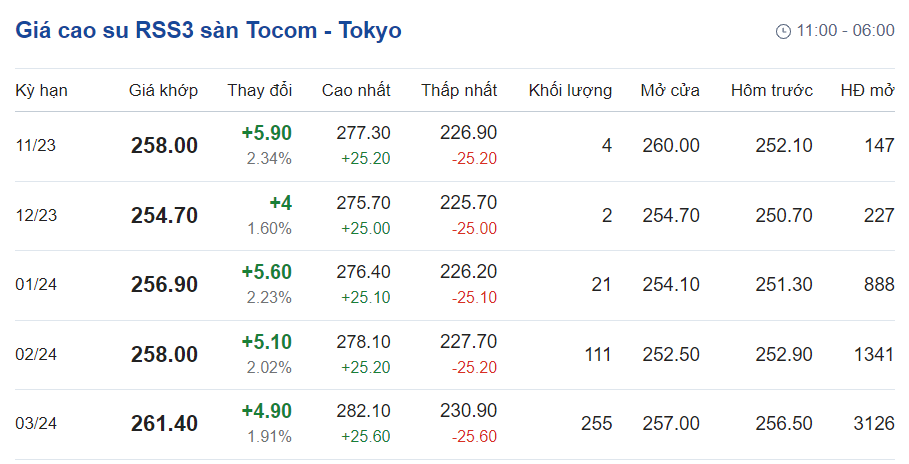
At the Tokyo Commodity Exchange (TOCOM), the price of rubber futures delivered in November 2023 reached 258 yen/kg, an increase of 2.34% (equivalent to 5.9 yen/kg) at the time of the survey. 6:20 am (Vietnam time).
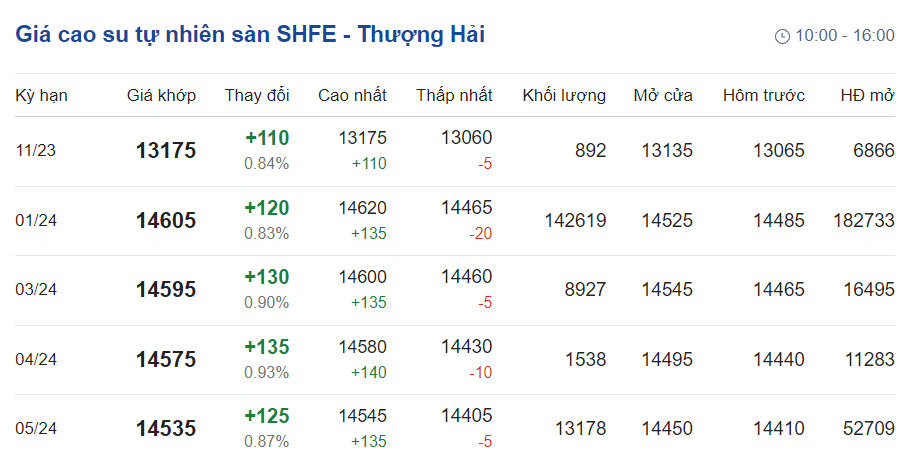
On the Shanghai Futures Exchange (SHFE), the RSS3 rubber price for November 2023 delivery was adjusted to 13,175 yuan/ton, up 0.84% (equivalent to 110 yuan). compared to previous transactions.
The Import-Export Department (Ministry of Industry and Trade) said that in the 10 days of mid-October, rubber prices in the Asian market tended to increase due to a sharp increase in crude oil prices and concerns about falling output at manufacturers. leading Thailand and Indonesia.
The period from mid-September 2023 to mid-January 2024 is usually the peak of rubber output globally, but the largest producers Thailand and Indonesia are facing a trend of decreasing output.
The Thai Metrology Department warns that severe weather, heavy rain, and strong winds can cause flash floods, affecting rubber supply. Besides, the market is expecting that economic stimulus measures in China will increase demand for rubber.
At the Osaka Exchange (OSE), the spot price of RSS3 rubber rose to a 16-month high of 351 yen/kg on October 17. After that, prices decreased slightly again but were still higher than 10 days ago due to concerns about supply shortages in Thailand.
In Thailand, RSS3 rubber price increased sharply compared to 10 days ago. On October 17, RSS3 rubber price was offered at more than 60 baht/kg (equivalent to 1.6 USD/kg), up 6% compared to 10 days ago and up 12% over the same period in 2022.
Unusual weather in Thailand's main rubber production areas has disrupted rubber harvesting, so raw material purchasing prices have continuously increased.
The Import-Export Department said many financial institutions believe that crude oil prices may remain high, indirectly supporting the increase in natural rubber prices. In addition, the recovery of rubber prices is also promoted when production activities in China are gradually recovering, helping to reduce rubber inventories.
China currently has many policies for the electric vehicle industry, positively impacting total rubber demand in this country. In addition, China's tire and tube exports have increased sharply in output and value since the beginning of the year, thereby boosting the country's demand for rubber.
The World Bank has raised its rubber price forecast for the whole year 2023 to an average of 1.4 USD/kg and in 2024 to an average of 1.5 USD/kg (corresponding to an increase of more than 7%).
Recorded from the latest report of the Import-Export Department (Ministry of Industry and Trade), in September 2023, China is still Vietnam's largest rubber export market, accounting for 80.88% in volume and 80% in volume. 41% in value of the country's total rubber exports.
Specifically, rubber exports from Vietnam to the Chinese market reached 156.34 thousand tons, worth 202.44 million USD, down 14% in volume and down 12.8% in value compared to August 2023. ; Compared to September 2022, it increased by 4.6% in volume, but decreased by 2.7% in value.
This is the 8th consecutive month that rubber exports to China have increased compared to the same period in 2022.
The average export rubber price to China is 1,295 USD/ton, up 1.4% compared to August 2023, but down 7% compared to September 2022.
Accumulated in the first 9 months of 2023, Vietnam exported 1.09 million tons of rubber to China, worth 1.44 billion USD, up 10.7% in volume, but down 8.1% in value compared to same period in 2022.
Notably, in September 2023, although rubber exports decreased, the amount of rubber exported to some markets still grew compared to the same period last year such as: Pakistan increased by 169.1%; Germany increased by 36.6%; Sri Lanka increased by 22.6%; Indonesia increased by 16.5%; US increased by 10%...
In the first 9 months of 2023, rubber exports to most markets decreased compared to the same period last year, especially markets such as India, Korea, USA, Germany, Turkey, Taiwan. Loan, Indonesia, Sri Lanka, Russia…
However, exports to a key market still grow in volume over the same period in 2022 such as: China, the Netherlands, Argentina, France...


